Written on 6:14 AM by Author

Inflacioni përbën një ndër sëmundjet më të rënda makroekonomike dhe konsiderohet si një problem shqetësues për ekonominë në tërësi dhe për firmat dhe konsumatoret në veçanti.
Me inflacion do të kuptojmë ngritjen e vazhdueshme të nivelit të përgjithshëm të çmimeve.
Me ngritjen e nivelit të përgjithëshem të çmimeve kemi parasysh ngritjen e nivelit mesatar të tyre.
Krahas inflacionit, me ndryshimin e nivelit të çmimeve lidhen edhe konceptet e deflacionit dhe të desinflacionit.
Deflacioni paraqet rënjen e çmimeve mesatare nën nivelin e periudhës parardhëse. Ndryshe deflacioni mund të përcaktohet si inflacion negative.
Desinflacioni paraqet rënjen e çmimeve mesatare,por duke mbetur mbi nivelin e periudhës paraprake. Pra gjatë periudhave desinflacioniste inflacioni vazhdon të ketë vlera pozitive.
Llojet e Inflacionit:
Në përgjithësi në teorinë ekonomike inflacioni klasifikohet në tre kategori:
Inflacioni i moderuar
Inflacioni galopant
Hiperinflacioni
Kostot e inflacionit janë më pak të dukshme se sa kostot e papunësisë sepse në një situatë inflacioniste mund të kemi njëkohësisht si të humbur ashtu edhe të fituar.Në një periudhë inflacioniste jo të gjitha çmimet, përfshirë këtu edhe pagat, ndryshojnë me të njejtin ritëm. Rrjedhimisht, do të kemi patjetër ndryshime në nivelin e çmimeve relative të mallrave dhe të shërbimeve. :
- inflacioni çon në rishpërndarjen e pasurisë midis klasave ose shtresave të ndryshme të popullësisë.
- inflacioni çon në një alokim joefiçient të burimeve të prodhimit.

|
Written on 9:32 AM by Author
- Emërtimi ekonomia vjenë nga fjala greke dhe përbëhet prej dy fjalëve:
- Oiko, që nënkupton shtëpinë, ekonominë shtëpiake dhe
- Nomos,që nënkupton rregullim, rend, ligj, normë parim në punën e ekonomisë shtëpiake.
- Ksenofoni me ekonomi kuptonte shkathtësinë e udhëheqjes së ekonomisë shtëpiake.
- Aristoteli, me ekonomi kuptonte shkathtësinë e prokurimit të të mirave për jetesë dhe të dobishme për shtëpi ose shtet.
- Shkencat ekonomike gjithnjë e më shumë po bëhen të rëndësishme.
- Prodhimtaria materiale sot duhet t’i përgjigjet të mirave materiale dhe shërbimeve bashkëkohore për plotësimin e nevojave të njerëzve, ku:
- Nevojat janë të pakufizuara,
- Mundësit e kufizuara
- Në kohën bashkëkohore nevojat e njerëzve ditë e për ditë shtohen, që njëherit përcakton edhe objektin e studimit të ekonomisë..
- Qëllimi i fundit i çdo ekonomie është ngritja e forcave prodhuese
- Ekonomia duke prodhuar të mira materiale të tashme, duhet të krijojë bazë materiale (begati të prodhuar) edhe për gjeneratat e ardhshme.
- Duke sublimuar të gjitha ato që u cekën më sipër mund të definojmë edhe ekonominë. Kështu, pra “ekonomia studion atë si i shfrytëzon shoqëria resurset e pakëta që të prodhojë mallra me vlerë dhe ato t’i shpërndajë në mes njerëzve të ndryshëm.
- Në kuptimin e plotë të fjalës ekonomia është disiplinë shkencore, e cila studion realitetin e gjithmbarshëm ekonomik dhe në vete ngërthen:
- Sistemin ekonomik dhe
- Politikën e zbatuar ekonomike
- Sjelljen e agjentëve ekonomik e përcakton sistemi ekonomik i një vendi. Pozita e subjekteve ekonomike është krejt tjetër në:
- Sistemin bogjes ekonomik-ekonominë e tregut dhe
- Sistemin e ekonomisë me plan dhe të dirigjuar.
- Për kah lënda e shqyrtimit, ekonomia ndahet në:
- Mikroekonomi, e cial studion treguesit në nivel të subjekteve ekonomike siç janë: të hyrat e ndërmarrjes, investimet, punësimi, shpenzimet e prodhimit, tregu, çmimet etj. dhe
- Makroekonomi, e cila studion funksionimin e ekonomisë në nivel kombëtar (të vendit), duke analizuar treguesit e gjithmbarshëm makroekonomik, si: Bruto produktin shoqëror (BPSH), produktin Shoqëror (PSH), të ardhruat kombëtare (TK0, investimet (I), Ppnësimin (P) etj.
- Sipas ekonomisë klasike borgjeze të gjithë faktorët e prodhimit klasifikojhen në tri grupe kryesore:
- Puna, ku përfshihet aftësia mendore dhe fizike e njeriut për të punuar dhe krijua ndonjë të mirë materiale, apo për të kryer ndonjë shërbim,
- Toka, e cila përfshin resurset natyrore të të gjitha llojeve, nëntokësore dhe mbitokësore e që shërbejnë si parakushte dhe kushte të zhvillimit dhe
- Kapitali që përbëhet nga begatia e prodhuar, që nga aspekti ekonomik përbëhet nga fondet kryesore (pajisjet, makineritë, ndërtesat etj.) dhe nga fondet xhiruese (rezervat, prodhimet e gatshme, prodhimi në proces, lëndët e para etj.).
- Gama e faktorëve të prodhimit është rritur varësisht nga ngritja e forcave prodhuese.
- Të gjtihë faktorët bashkëkohor të prodhimit Samuelson i klasifikon në tri grupe kryesore, pa maarrë parasysh nivelin e zhvillimit ekonomik të vendit, e që janë:
- Ç’duhet prodhuar? Cilin lloj dhe çfarë sasie të prodhimit)
- Si të prodhohet? (kush t’i prodhojë, me çfarë resurse dhe me cilën mënyrë teknologjike) dhe
- Për kë të prodhohet? Kush do t’i përvetësojë të mirat materiale, përkatësisht si do të shpërndahen ato midis klasave të ndryshme?
- Këto tri dimensione paraqesin problemin qendror të ekonomisë, zgjidhja e të cilave varet nga sistemi dhe niveli i zhvillimit të forcave prodhuese, përkatësisht nga zgjidhja e:
- Inputeve (hyrjeve) dhe
- Outputeve (daljeve) ekonomike
- Në këto tri elemente mbështetet e tërë ekonoia e një vendi, qoftë kur është fjala për ekonominë e tregut të lirë, qoftë për ekonominë me plan dhe të dirigjuar.
|
Written on 7:57 AM by Author

Price discrimination exists when sales of identical goods or services are transacted at different prices from the same provider. In a theoretical market with perfect information, no transaction costs or prohibition on secondary exchange (or re-selling) to prevent arbitrage, price discrimination can only be a feature of monopoly and oligopoly markets[1], where market power can be exercised. Otherwise, the moment the seller tries to sell the same good at different prices, the buyer at the lower price can arbitrage by selling to the consumer buying at the higher price but with a tiny discount. However, market frictions in oligopolies such as the airlines and even in fully competitive retail or industrial markets allow for a limited degree of differential pricing to different consumers. Price discrimination also occurs when it costs more to supply one customer than it does another, and yet the supplier charges both the same price.
Although the term "discrimination" has negative (e.g. racist, sexist) connotations in common usage, the meaning of the word "discrimination" (from the Latin word discriminatio, "a distinction") is neutral. "Price discrimination" is a technical term meaning only differentiation in price by customer, and is not intended as an accusation of illegal or unethical behavior.
The effects of price discrimination on social efficiency are unclear; typically such behavior leads to lower prices for some consumers and higher prices for others. Output can be expanded when price discrimination is very efficient, but output can also decline when discrimination is more effective at extracting surplus from high-valued users than expanding sales to low valued users. Even if output remains constant, price discrimination can reduce efficiency by misallocating output among consumers.
Price discrimination requires market segmentation and some means to discourage discount customers from becoming resellers and, by extension, competitors. This usually entails using one or more means of preventing any resale, keeping the different price groups separate, making price comparisons difficult, or restricting pricing information. The boundary set up by the marketer to keep segments separate are referred to as a rate fence. Price discrimination is thus very common in services, where resale is not possible; an example is student discounts at museums.
|
Written on 4:55 AM by Author
 The first coins were minted in Lydia, an ancient empire in the area of modern Turkey. The Lydian king Croesus started making small metal ingots stamped with an imperial emblem around 640 B.C.
This Lydian custom spread to the Greeks and eventually to the Romans. Coins were usually made of silver or gold, and their value was enforced by the authority of the government that issued them. If the Athenian officials declared that all coins minted in Athens, with the official stamp of Athens, were 97 percent silver, then those coins would be traded at that value.
In China, coins developed at about the same time that they did in the West. In the fifth century, B.C., the Chinese began using a form of commodity currency in the shape of knives or other tools. The metal blades had a round hole at one end, so the money could be strung onto a rod or rope. Eventually, the tools became more stylized. Over the years, they became smaller and smaller, until only the round end with a hole in it was left. These round, pierced Chinese coins remained virtually unchanged until the 1800s.
Making Money Pays When the U.S. Mint creates coins, seigniorage -- the difference between the value of money and the cost of its production -- means instant profit. According to the U.S. Mint, it only takes a few cents to mint a quarter, but the quarter is instantly worth 25 cents. That difference is the money that keeps the mint running.
|
An important effect of coins was that
governments now controlled the release of money into the market. They could also
manipulate the money supply. This was done by various Roman emperors, who would reduce the precious metal content of Roman coins when they needed money. They figured that if a ton of gold made 10,000 gold coins, they could have twice as many coins by cutting the gold content in half. Instead of making the emperors richer, the constant devaluation of Roman coins -- and the resulting instability of the Roman economy -- is one of the factors that led to the fall of the Roman Empire.
When Rome fell, most of Europe returned to a more primitive, feudal system of economy. Throughout the Dark Ages, people became distrustful of coins, and that currency fell out of use. Coinage wouldn't return until the Renaissance.
|
Written on 4:44 AM by Author

|
Written on 8:43 AM by Author
Ancient times
Sumer developed a large scale economy based on commodity money, while the Babylonians and their neighboring city states later developed the earliest system of economics as we think of, in terms of rules/laws on debt... legal contracts and law codes relating to business practices, and private property.[1]This was the beginning of the price system as is known today... when it was formalized.[2]
The Babylonians and their city state neighbors developed forms of economics comparable to currently used civil society (law) concepts.[3] They developed the first known codified legal and administrative systems, complete with courts, jails, and government records.
Several centuries after the invention of cuneiform, the use of writing expanded beyond debt/payment certificates and inventory lists to be applied for the first time, about 2600 BC, to messages and mail delivery, history, legend, mathematics, astronomical records and other pursuits. Ways to divide private property, when it is contended... amounts of interest on debt... rules as to property and monetary compensation concerning property damage or physical damage to a person... fines for 'wrong doing'... and compensation in money for various infractions of formalized law were standardized for the first time in history.[1]
The ancient economy was mainly based on subsistence farming. The Shekel referred to an ancient unit of weight and currency. The first usage of the term came from Mesopotamia circa 3000 BC. and referred to a specific mass of barley which related other values in a metric such as silver, bronze, copper etc. A barley/shekel was originally both a unit of currency and a unit of weight... just as the British Pound was originally a unit denominating a one pound mass of silver.
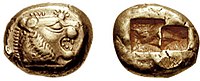
A 640 BC one-third stater coin from Lydia, shown larger.
According to Herodotus, and most modern scholars, the Lydians were the first people to introduce the use of gold and silver coin.[4] It is thought that these first stamped coins were minted around 650-600 BC.[5] A stater coin was made in the stater (trite) denomination. To complement the stater, fractions were made: the trite (third), the hekte (sixth), and so forth in lower denominations.
For most people the exchange of goods occurred through social relationships. There were also traders who bartered in the marketplaces. In Ancient Greece, where the present English word 'economy' originated, many people were bond slaves of the freeholders. Economic discussion was driven by scarcity. Aristotle (384-322 B.C.) was the first to differentiate between a use value and an exchange value of goods. (Politics, Book I.) The exchange ratio he defined was not only the expression of the value of goods but of the relations between the people involved in trade. For most of the time in history economy therefore stood in opposition to institutions with fixed exchange ratios as reign, state, religion, culture and tradition.
|
Written on 8:20 AM by Author
The economy is the realized social system of production, exchange, distribution, and consumption of goods and services of a country or other area. A given economy is the end result of a process that involves its technological evolution, civilization's history and social organization, as well as its geography, resource endowment, and ecology, among other factors. These factors give context, content, and set the conditions and parameters in which an economy functions. An economy does not have to be a specific size. An economy can mean the economy of a city (local economy), a country (national economy) or the world as a whole (international economy), provided that it is involved in the production of goods and services.
The word "economy" can be traced back to the Greek word "one who manages a household", derived from οἴκος, "house", and νέμω, "distribute (especially, manage)". From οἰκονόμος "of a household or family" but also senses such as "thrift", "direction", "administration", "arrangement", and "public revenue of a state". The first recorded sense of the word "economy", found in a work possibly composed in 1440, is "the management of economic affairs", in this case, of a monastery. Economy is later recorded in other senses shared by οἰκονομία in Greek, including "thrift" and "administration". The most frequently used current sense, "the economic system of a country or an area", seems not to have developed until the 19th or 20th century.
Today the range of fields of study exploring, registering and describing the economy or a part of it, include social sciences such as economics, as well as branches of history (economic history) or geography (economic geography). Practical fields directly related to the human activities involving production, distribution, exchange, and consumption of goods and services as a whole, range from engineering to management and business administration to applied science to finance. All kind of professions, occupations, economic agents or economic activities, contribute to the economy. Consumption, saving and investment are core variable components in the economy and determine market equilibrium. There are three main sectors of economic activity: primary, secondary and tertiary.
|


